
Cartooning 101
The complications behind simplicity...

Recently, a reader who we’ll call “Mandy” mostly because that’s her name, observed that this drawing of the Oval Office did not include all the gold-plated crap Trump has collected in the Oval Office and I gave her a flippant answer (my specialty) and said if I had to draw all Trump’s gold-plated crap, the cartoons would take forever, which isn’t totally wrong, but isn’t the full explanation either.
Assuming you’re interested (and if you’re not, now would be an excellent time to stop reading):
I worked for two newspapers—the Sacramento Union and the San Diego Union—before coming to Kansas City and the readers in Sacramento and San Diego were not clamoring to hear my personal views or behind-the-scenes stories, possibly because the Sacramento Union was the second newspaper in a two-newspaper town that very few people cared about (including many of the people who worked there) and everybody who wasn’t a multi-millionaire or an active member of the American Nazi Party hated the San Diego Union (including many of the people who worked there).
But…
I get to Kansas City and the Times and Star are a Really Big Deal and I’m getting requests from TV stations, radio stations, Chambers of Commerce, churches, book clubs and Cub Scout Packs to come speak to them. (After a few appearances at high schools and grade schools I figure out why I’m so popular with teachers: when I show up, they don’t have to prepare a lesson plan.)
But I’m also no slouch when it comes to avoiding work and realize these public appearances are a lot easier if I show some cartoons. Then all I have to do is play straight man to my own work and remind the audience of the news event that led to the cartoon I’m showing, like the time Ronald Reagan had part of his colon removed:

Normally, you draw a cartoon and publish it in the paper and have no idea if anyone hated or loved it unless they write a letter and that takes a week or more. But while I’m making these public appearances, I’m figuring out what makes people laugh and what doesn’t and finding out immediately-right-now-this-second and also discovering why stand-up comedy is so emotionally brutal:
If you’re a singer and finish a song, it’s customary for people to applaud, even though you forgot the words to Wichita Lineman and started singing an out-of-key version of By the Time I get to Phoenix halfway through the song.
Having covered baseball for ten years I’ve heard a huge collection of singers torture the National Anthem like it was an Abu Ghraib prisoner and still get a round of applause even after those singers conclusively proved they couldn’t hit that high note on “Land of the FREEEEEEE” but went for it anyway.
And we’ll now take a short break to watch Olympic sprinter Carl Lewis absolutely butcher the National Anthem and the very best part of this 1 minute and 15 second video is the reaction of the ESPN anchors:
If you’re a standup comedian there is no point where it’s customary for people to laugh, so it’s up to you to make them laugh and when that doesn’t happen, trust me, it’s awful.
A Quick Story About My Worst Public Appearance Ever

One of my best friends is Bill DeOre (former cartoonist for the Dallas Morning News—seen here watching Nancy Pelosi be waterboarded) even though Bill’s a Conservative and says my Liberal cartoons make him want to “dip snuff” which is some kind of put-down if you live in Texas, but I don’t so, fuck Bill and the cartoon elephant he rode in on.
We’re mainly friends because we make each other laugh in-between insults.
So I’m getting all these invitations to speak and I like hanging around with Bill, so I tell people that they ought to invite Bill too and I’ll give the Liberal Point of View and Bill will give the Flaming Asshole’s Point of View and then we’ll take questions from the audience.
Together, we put on a pretty good show and I get Bill appearances at classy places like MU, KU and Harvard and he returns the favor by getting me an invitation to his alma mater, Texas Tech, which is located in Lubbock, Texas and I soon find out why Buddy Holly left.
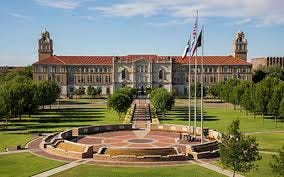
We’re talking to an auditorium full of Texas Tech students and I’m going first and Bill’s running the slide projector loaded with my cartoons. I know I’m Deep in the Gallbladder of Texas and only bring my killer cartoons; the ones that never fail to get a laugh as long as you’re not within the Lubbock area code.
Because I get NUTHIN’.
Not a snicker, not a guffaw, no sign that the Texas Tech students aren’t on Life Support.
So now it’s Bill’s turn to speak and I’m going run the slide projector for him and as we pass each other to exchange places, Bill leans in and whispers: “See? That Liberal Shit don’t fly down here.”
Now Bill’s going to show me what’s what and teach me a lesson, so he starts in on his If-Heinrich-Himmler-Could-Draw collection of cartoons, ridiculing Liberals and Our Goofy Ideas because we’re now in God’s Country (assuming God started the John Birch Society) annnd…
Bill gets NUTHIN’.
Not a snicker, not a guffaw, no sign that the Texas Tech students aren’t on Life Support.
Absolutely no reaction from the apparently freeze-dried student body and I’d say Bill’s appearance was just as bad as mine, but that isn’t so because don’t forget: I was running the slide projector.
Bill quickly realizes he’s dying just as bad as I did and wants to get off the stage as soon as possible, but I won’t let him.
Instead of going to the next slide when he asks me to, I draw things out and suggest additional stories and anecdotes he could tell about the cartoon that didn’t get a laugh and the stories and the anecdotes don’t get a laugh either and the only person in the auditorium enjoying all this is me.
But I can highly recommend watching your best buddy die on stage right after you did the same thing, so if you get that opportunity, don’t pass it up.
What Works On Stage, As Long As the Stage Isn’t In Lubbock, Texas
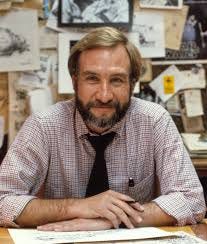
Next, we’ll set the Wayback Machine to the late 1970s and now I’m in the audience and Tony Auth—Philadelphia Inquirer—is showing his cartoons and some sketches he couldn’t get published. Tony says the next cartoon was drawn after evangelist Billy Graham came out in favor of castration for sex offenders. The sketch is really really sketchy, but shows Billy Graham standing next to a guillotine with a hole where the victim’s head would normally go through, but this hole is small and crotch high.
The audience EXPLODES with laughter.
I’m sitting in the dark thinking, “It’s the idea, not the art” which might seem obvious to you, but wasn’t to me back then; I became a cartoonist because I liked to draw, not because I was chock-full of great cartoon ideas.
Time—and terrific artists like Jeff MacNelly, Pat Oliphant and Don Wright—would teach me I wasn’t nearly as good an artist as my mom and I previously thought, so I learned to focus on the ideas and the point I was making, which is without a doubt the hardest part of cartooning.
Turned out, if I had a shitty idea, I didn’t draw well enough to hide that fact; if I had a good idea, I didn’t draw poorly enough to screw it up.
But to get the most out of my cartoon ideas, I had to learn to get out of my own way.
There’s more than one way to skin a cat (which is extremely bad news for cats) but in my experience cartoons with lots of details work better in print; the reader can take his or her time and focus on all the funny book titles you put on the bookshelf in the background or the goofy birds you put in the trees, but lots and lots of details do not work well in front of a live crowd.
The details slow down the crowd’s reaction because you gave them too much to look at and absorb; it’s like telling a joke with a three-paragraph punch line.
In my case I want the reader to have one thing to focus on, so I learned to bullshit my way through backgrounds and foregrounds and give just enough details to inform readers the action is taking place at a boxing match…

Or on a bus…

Or in the Oval Office…

But wait—just like a Ginsu knife commercial—there’s more.
Avatar
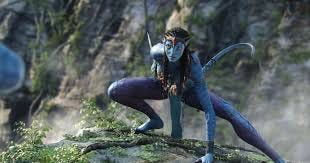
In 2009 I take my kids to Avatar which is in 3-D and is two hours and 42 minutes long, so you know I went home with a headache, but while wearing those crappy 3-D glasses I realize James Cameron is making the main point of interest pop off the screen by keeping everything else slightly out of focus.
So I start experimenting with gray markers and pens on the foreground and background (having a foreground and background adds depth to an image) and the only solid blacks are used where I want you to look.

And the blacks are solid because with all the gray in a newspaper, solid blacks and whites attract the eye.
I sometimes had to fight editors over this because they couldn’t understand why I wasn’t using all the available space and I’d point out the most expensive and best designed newspaper ads used lots of solids that draw the reader’s eye and the shitty, cheap ads were crammed with tons of information nobody looked at.
But to use solids effectively, you have to resist the temptation to draw and show off, but once you realize all that drawing and showing off isn’t helping—it’s hurting your idea—it became a lot easier to stop.
Next Up—Color
With the same sort of financial acumen that led some people to invest in zeppelins right before the Hindenburg explosion, the Kansas City Star decided to buy new printing presses and build a printing plant right before newspaper industry imploded, but those new presses meant we could print color on the editorial page, which—having worked in Black & White all my career—I found challenging.
I originally resisted because I thought my color efforts looked like crap, but I only thought that because they did. My first color cartoons looked like a hyper-active third grader had been given the big set of Crayolas and decided to use every one of them.
But then I got a collection of Voutch cartoons (he’s French) for Christmas and the scales fall from my Black & White eyes.
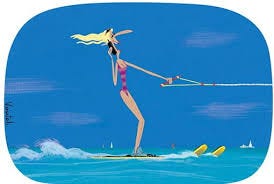
Generally speaking, Voutch establishes a dominant color (this one’s blue) and if things that aren’t normally blue have to be blue in service of the cartoon, so be it; it’s our cartoon world and we can do whatever we please.
Once you establish the dominant color, you use complimentary colors on your main point of interest and if you don’t know your complimentary colors, get a color wheel.
You soon realize everybody’s using a color wheel because blue and yellow (the Golden State Warriors) look good together and so does purple and yellow (the Minnesota Vikings) and blue and orange (the New York Mets) and browns and blacks are neutral and go with pretty much anything although the Browns don’t win many football games.
Word of warning:
If your main point of interest has to be a certain color— for example, Santa Claus’ red suit—the main point of interest will define the dominant color, not the other way around and yes, I figured that out the hard way.
Today’s Lesson
Whether it’s a short story or fielding a 112-MPH grounder or drawing a political cartoon, making something look simple is usually complicated.
But we don’t realize all the work someone had to do to make something look simple so we assume it is simple and because it’s a holiday I was kind of bored and decided to explain what you see and don’t see in my cartoons, and, Mandy, thanks for the essay idea.
It’s not the only way to draw cartoons, but is my way and even though it’s a holiday for the rest of you, I now need to get started on one.
Have a nice Memorial Day, everybody.
Just hearing the words "Kansas City Times" took me back. ❤️
The "Reagan no longer a complete asshole" cartoon hooked me forever to your sense of humor.
And speaking of making complicated things look easy, how about Bobby Witt playing shortstop?