
Observe By Watching
A guide to Spring Training…
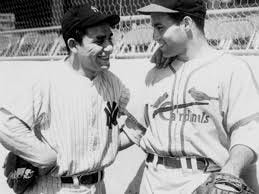
As Yogi Berra probably didn’t say, “You can observe a lot just by watching.”
And I say Yogi probably didn’t say that because I once met Joe Garagiola—Yogi’s buddy—and Joe said Yogi didn’t say a lot of things he supposedly said, but even if Yogi didn’t say it, he had a point.
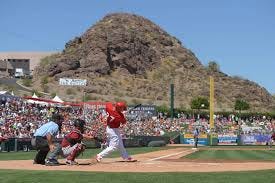
BTW: This picture is from Tempe Diablo Stadium and I once got to manage a game there and called time to talk to my pitcher and when he asked why I was out there, I said I just wanted to stand on the pitcher’s mound, in the middle of that diamond and look around because it was a pretty cool place to be, so we both took a moment and did that.
Anyway…

The Kansas City Royals spring training complex in Surprise, Arizona has two-and-half major league practice fields (the half field’s just an infield) and four minor league practice fields called a “cloverleaf” and in this picture of the Royals/Texas Rangers complex those are the four fields with home plate back-to-back (so coaches, players and front office people can go from one field to another quickly) and if you show up in the morning (like between 9 and 11, check for times) you can watch practice for free.
Which is maybe the best bargain in baseball and if you know what to look for you can observe a lot just by watching, and now that we’ve got all that out of the way, I’ll give you a few things to watch for.
The Morning Stretch
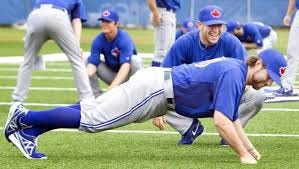
First thing on the schedule is the morning stretch, although at the Surprise complex you might not be able to get close enough to field where the Big Leaguers stretch (access to the Big League fields is limited) which is too bad and here’s why:
I was watching the pregame stretch (the team wasn’t the Royals and some of the names in this article are going to be deleted to protect the guilty) and the Stars on the team weren’t doing the stretches; they were walking around talking instead and when I pointed that out to a coach of my acquaintance, he didn’t like it.
Here’s why the stretch matters:
The Stars were sending the message to the rest of the team that once you have enough success you can ignore the coaches and trainers and do whatever you feel like doing and before that season was over, the team tanked and the coach apologized and said I was right about the Stars not stretching.
It might seem like a small thing, but it isn’t and you could see the problem developing weeks before Opening Day.
And don’t be surprised if the guys not stretching pull a hamstring in August.
Star Players
Since already we’re in the neighborhood, we should talk about Star Players and the balance of power because it’s a big deal and every season it starts in spring training; if you want to understand baseball and your favorite team, you need to understand this.
In grade school, high school, college and, depending on a player’s signing bonus, the minor leagues, the coaches have the power to hand out playing time or advance players to the next level.
If you’re a player hoping to advance from Single A to Double A, being a pain in the ass is a bad idea, but once you get to the Big Leagues, the balance of power changes and if a Star Player making $21 million a year for next seven years gets in an argument with a coach making $200,000 a year for the next two years, guess which one’s in trouble.
And a Star Player might call his agent to complain about a coach and the agent complains to the team GM and the team GM talks to the manager and the manager talks to the coach and says we all know Bobby/Jose/Elroy is a complete horse’s ass, but try to get along with him because it’ll be a lot harder to get rid of Bobby/Jose/Elroy than you.
Star Players have a lot of influence and their behavior matters because all the players who want to be Star Players will follow them.
If a Star player buys into the team’s philosophy and takes the drills seriously and demonstrates that “this stuff matters” the team has a better chance of succeeding and you can spot Star Player behavior at a spring training practice.
So whatever you’re watching, pay attention to the Star Players and you can spot a Good Guy or a Clubhouse Cancer before the season ever starts and if analytics has come up with a metric that measure how just big an asshole someone is, I have yet to hear about it.
OK, remember all this as we move on to…
Pitcher’s Fielding Practice
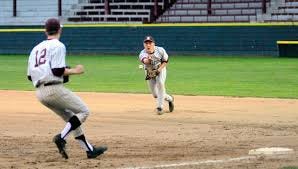
The very first drill they do in spring training are PFPs, which means “Pitcher’s Fielding Practice” unless you’re a player and then you call it “Pitcher’s Fucking Practice.” And here’s what I have to say about PFPs:
What you can observe just by watching pitchers covering first base, is a lot of them don’t take it seriously and screw around and then fuck it up when they have to do it under pressure in a game that counts.
Here’s what to watch for:
Pitchers have to break for first base on every ball hit to their left and they have to break right away and can’t wait to see if they’re needed because then they’ll be late. Anytime you see a ball hit to the pitcher’s left and he doesn’t break immediately—even if he’s not needed—you’re seeing a future problem.
Pitchers don’t run directly to the bag, they run to the first base line, then turn left and run parallel with the line because that way they don’t cross the runner’s path. After they reach the line and make their turn, they hold up their glove chest high and the first baseman is supposed to get them the ball before they reach first base.
Pitchers who are lazy and don’t take this drill seriously, tend to break late and run straight to the bag to beat the runner, which means they’re trying to catch the ball and step on the base at the same time (which often turns into a train wreck) and if they cross the runner’s path they risk injury to both players and we see this screwed up every year and if you paid attention during spring training, you could see this coming.
Disorganized Practices
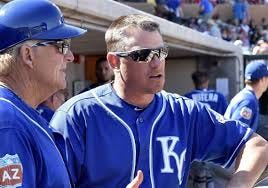
Mitch Maier is one of my all-time favorite Royals and after he became a coach I ran into him one morning at spring training and I asked what he was up to and Mitch said he’d been busy setting up a pitching machine.
We talked about the importance of being organized because you’re trying to convince the players to buy into the team’s philosophy and if they show up for bunting practice at 9 AM and the pitching machine isn’t there, it makes them think the team and coaching staff don’t know what they’re doing.
Why should a player listen to a coach about changing his swing when the coach can’t even get a pitching machine set up on time?
I’ve heard of a first-year manager (this is one of those names I won’t name) losing his team’s confidence because his first spring training was so disorganized. If you see a bunch of players standing around waiting and that goes on too long, you’re watching a disorganized organization and that’s a bad sign.
And Now A Look At Organized Practices
So you’ve got six–and-a-half fields and close to 200 players, which means you’ve got to figure out who’s on what field doing what when and how many days you want to work on cutoffs and relays and who’s playing in a road game that day and who’s staying home and if you have a split-squad game, what Big Leaguers are going with which squad (I don’t know if it’s still a requirement, but teams had to play at least four Big League players at some point in a spring training game) and if you’re playing a divisional opponent, maybe you want your starting pitcher working in a minor league game so the divisional opponent doesn’t get another look at him and if you do that where does the minor league pitcher pitch that day?
Bottom line: If you’ve got six fields working on bunting, but only five working pitching machines, you’ve got a problem.
And all this has to be worked out before the first player shows up.
So a disorganized practice tell you something, but so does an organized practice and when you see one running smoothly, give credit to guys that organized it.
Instructional Meetings
Yes, that was Rusty Kuntz in the picture with Mitch Maier and one day I was watching Rusty talk to maybe six players and when he got done, that group moved off to their next activity and another group of six players gathered and Rusty said the same exact stuff to the second group and the third group. so Rusty was repeating himself over and over and since I’m a dope, I asked why he didn’t talk to everybody at once.
Rusty said if I talk to everybody at once, someone at the back of the group won’t be listening; if I talk to six guys at a time I can make eye contact with all of them and they have to pay attention. This is why Rusty Kuntz is and/or was considered a great coach (no idea what they have him doing now) and I wasn’t.
If you want to know the kind of thing Rusty was saying to his players—and you should—here’s a two-minute video on bunting:
So pay attention to group meetings and how big they are and who’s locked in and who’s horsing around at the back of the group and don’t be surprised if the horsing-around-guys are the same guys who don’t get their bunt down during the regular season.
The Daily Fundamental
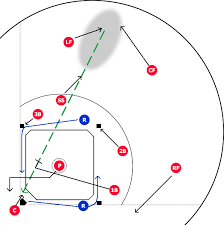
Wandering around the back fields is like auditing college classes: you get to listen to instruction and see how things are done, which makes the games way more interesting.
When I covered the Royals they’d have a “daily fundamental” and all six fields would have players working on the same thing in the same way because you don’t want cutoffs and relays in Omaha done differently than cutoffs and relays in Kansas City.
Fans and the media don’t think about it, but when a team acquires a player from a different organization it might take some time to get up to speed because the player has to learn how things are done in his new organization and I once watched a newly-acquired centerfielder misplay some balls in Kauffman Stadium because when he was looking up, tracking a fly ball, he still wasn’t 100% sure where the wall was.
I’ll give you one Daily Fundamental example and something to look for:
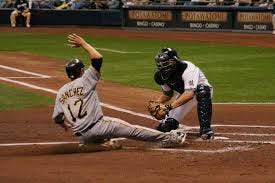
One day I was watching the Royals work on throws to home plate and they wanted all the throws to bounce once and the bounce needed to be on the infield grass so the catcher would have a nice, long hop to deal with, not a short hop right in front of home plate.
We think a throw that doesn’t bounce at all would be ideal, but it’s probably going to come in low and then the catcher has to worry about dealing with a short hop, so bounce it intentionally on the infield grass and take that worry away: the catcher’s got enough problems already.
And once you watch that cutoff-and-relay practice, then you know when someone does it right (or wrong) in the Big Leagues.
Batting Practice
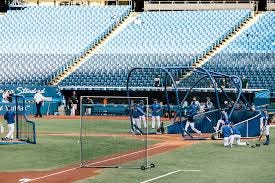
BP is done in groups—one group hitting, one group getting ready to hit and one group shagging flies—and smart teams put the same kind of hitters in the same groups because if you put a singles hitter in with the Big Boys, he’ll want to hit home runs, too.
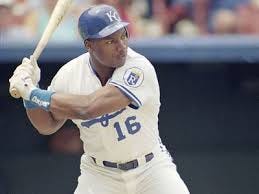
George Brett once told me he’d hit with Bo Jackson and Bo would hit tape-measure shots and then George would get competitive and want to show he could do the same thing and get done with BP and think he didn’t work on any of the things he should have been working on.
Focus on whether the players take the appropriate kind of batting practice for the kind of player they are and while long BP fly balls caught on the warning track might look better than a groundball hit to the opposite field, that long fly ball is an out and that groundball can get through for a single or advance a runner.
Today’s Lesson
I could go on…and on…and on about baseball (my former friends and current family will confirm that) but I gotta stop somewhere and this is it: there’s always something to see if you know where to look and what you’re looking at.
If you’re lucky enough to go to spring training, show up for the morning practice, go have a leisurely lunch somewhere, then come back for the afternoon game (you’ll have to buy a ticket for that) then get dinner and drinks (you’re going to be dehydrated and when people in Arizona tell you “it’s a dry heat” feel free to steal my line “they say the same thing about Hell”) and in my book and possibly yours, that’s a day well spent.
Then get up and do it again tomorrow, and remember what Yogi Berra might have said:
You can observe a lot just by watching.
Cannot thank you enough for all these gems, especially Uncle Rusty's bunting video.
I wish Rusty would adopt me so I could live him with and soak up baseball wisdom. Is it too late?
Please feel free to go on and on about baseball: I'd like to sue somebody in order to get Judging the Royals resurrected.
My favorite Yogi-ism, whether real or not: he was showered and dressed in the clubhouse after a very hot day game and the wife of one of the owners complimented him on his searsucker suit, saying he looked cool, meaning it should help cope with the heat.
Yogi: "Thanks. You don't look so hot yourself."
I agree with Terry Payne—please feel free to go on and on about baseball. Your guide is excellent and insightful. Spending time on the back fields is so interesting. If you can hear what the coaches are saying it’s a graduate-level class in baseball. And, hanging around the backfields avoids the massive crowds at the field where all the major leaguers are. Many of the drills they do are the same ones that have been done for a hundred years. And really, they need to practice bunting more. Great video! Once, at a previous Spring Training, a small group of friends and I sat down to watch PFP. After about 5 min they were all ready to go see something else and I told them I’d meet up with them later. I was fascinated! I wanted to get out there and run the drill!
The world would pay big money to someone who would invent an asshole quantifier/qualifier. So useful.